Showing posts with label critique. Show all posts

Tuesday, 20 March 2012

Fine Arts: Ghada Amer, Valerie Blass, Wangechi Mutu at the MACM

...a refreshing experience...

After the very dissapointing Triennale Québécoise, I didn't have much faith in the Montreal Museum of Contemporary Art.  I actually refrained from reviewing that last exhibit because I really wasn't impressed (but maybe there was something that I just didn't get, whatever).  So today, I walked into the museum with zero expectations, and sure enough, I was pleasantly surprised!

Like always, there are two entrances, but I always head for the right side first, probably out of force of habit or out of western convention.  I was then confronted by the brilliant installation/sculptures of Wangechi Mutu, namely the floor-to-ceiling glittery covering that encased a 'hidden' video room.

What I enjoyed about this first impression is that it sets a mood: the light is dim, the walls aren't completely white, there is faint music coming from the projection...  Somehow, I didn't care too much about subject matter because I was more attracted to the visuals and their experiencial quality.


Wangechi Mutu, Untitled.


Next up, Ghada Amer.  The bright light from the usual white walls feels a little stark and traditional, and from afar, her work looks like the usual ol' abstract paintings that we're all so accustomed to see in contemporary art museums, but she brings out a few surprises that set her apart from the norm.


For one, in each of her 'abstractions', there are detailed female figures under the many strings of colour that trap their bodies and hide them from our first impression.  In fact, the viewer has to walk up close to the 'painting' in order to see them properly.  I really admire this quality because I feel that it's telling us to 'look closer' and see beyond the lines, which is something that our fast-paced technology-driven society needs to remember again.


It's indeed pretty sexual and feminist and whatever.  Once again, it's not the actual subject matter that interested me, but rather, the use of materials and how the viewer can interact with it.  Amer works with fibers, and her 'paintings' are all embroidered!  So those lines you see are not drawn, but sewn-in with thread.  I guess that's the second surprise if anyone thought that it was just a regular ol' painting.


Finally, there were the sculptures of Valérie Blass. At first, I was a bit taken aback of the bland display and the awkward layout of the space... but the work itself was dynamic. 


However, it really was the last room (or first if you start from the left side) that grabbed my attention.  The sculptures, plainly, freaked the shit outta me...and I kind of didn't want to 'look closer' because they were oddly disturbing.  It could be that they were human-scaled, so it felt that they had a lively presence.  But after getting used to them, I was able to observe more carefully.  She really wants her viewer to 'experience' the sculptures, so this was indeed very successful!


Conclusion

A very well curated show.  Whether someone starts from the left or from the right, it doesn't make much a difference because they will both encounter an impressive first experience!

Ghada Amer, Valérie Blass and Wangechi Mutu are exhibited at the Musée d'Art Contemporain de Montréal from February 2nd to April 22nd 2012.

Sunday, 20 November 2011

Fine Arts: Leiko Ikemura at The National Museum of Modern Art, Tokyo

...figures in transient space...


Transfiguration, a retrospective by Japanese artist Leiko Ikemura, was exhibited at The National Museum of Modern Art (Tokyo).  I went there on a whim, so I didn't know anything about this artist before. 

The experience was normal. There were a few works that really stuck out, but I wasn't awed to the floor. I didn't think any of it was bad; I guess it just wasn't to my liking.  Seeing art is a bit like falling in love; it strikes chords in your heart, usually inexplicable, and just draws you in.  I didn't have that feeling this time, but I did appreciate her technical skill, along with her cohesive working theme.


Her paintings were of beautiful quality, in terms of materials. It was perhaps the subject matter that I simply didn't care about, but the paint itself was gorgeous.  I stood for a long time, looking at Red Trees.  I loved how she used jute instead of regular canvas; that raw feeling, soaked in that lush red, almost like pulsating blood, was indeed a sight to marvel at.  It also felt strangely meditative, but this was perhaps due to the room it was located in.


That room also housed a series of her sculptures, these creepy busts of indistinct portraits.  They stood behind a glass on the left side, and they were mirrored by writing on the opposite olive green wall.  The text was all in Japanese, so I couldn't read it, but there was a translation on the furthest wall before leaving the room.  It spoke about a tale that was later revealed as a dream. I must admit, with the serene yet creepy sound playing in the background, it was undeniably an interesting feeling. This was perhaps the most thought-provoking room of the exhibit.


I'm not a sculptor, so I can't really comment on them.  But I thought it was pretty amazing to be able to paint and sculpt, while keeping their aethetics very similar.  Ikemura's graps of these two disciplines really complimented eachother, and it seemed like her oeuvre worked best when they co-existed.

While searching for the images above (because we can never take photos inside the gallery!), I found these awesome drawings/watercolours that I'd like to share. They weren't exibited, but I'm sure if I saw them, I'd be drawn in.


Conclusion

The retrospective wasn't mind-blowing, but there were certainly pieces to marvel over.  It was good to learn about a new artist, and see her progression throughout the years. 

Tranfiguration by Leiko Ikemura was held at Tokyo's National Museum of Modern Art, from August 23rd to October 23rd, 2011.

Wednesday, 2 November 2011

Fine Arts: James Turrell in Naoshima

...feel the delight of light...


You really have to experience James Turrell's work in order to understand it.  I never really thought much about the artist before encountering his work in Naoshima, Japan.  I only vaguely remembered his name from one of my art history classes.  He's apparently most famous for his ambitious project, Roden Crater, an open-eye observatory near Flagstaff, Arizona. 

I instead got acquainted with two different artworks: Backside of the Moon and Open Field.


Minamidera

Picture of the plaque outside Minamidera

The Benesse Art Site is quite awesome in itself, but one of the best works was no doubt Backside of the Moon.  There is a bit of procedure when entering the room, but we weren't told much about what the work will actually consist of.  We were first directed into a very dark room and sat on a bench while "looking" at what lies in front of us.  I think we had to sit for maybe 8 minutes before our eyes adjusted to the very faint light source.


Once our eyes adjusted, we were allowed to walk around, and towards the source.  It was a strange rectangular "hole" in the wall.  I put my head out, like looking out a window, and it felt like falling into nothingness... but this nothingness was a hazy, misty, dim light (which complements the black-nothingness we were first introduced to when walking in the dark.)

It was cool. A bit creepy. And rather meditative.


Outside of Minamidera


Chichu Art Museum


Next up was the Chichu Art Museum.  A little bit on the pricey side, but really worth it.  As much as I loved Turrell's Open Field, I have to admit that the best part of the museum was the building itself (designed by architect Tadao Ando).  It was SO COOL!   Such a weird conception of space, and I loved the open-air concept. 

But back on the subject of Open Field... Once again, I thought it was a bit of a "creepy" experience, but this time, it felt like I was in some strange lab experiment.  We first walked into a clean white room and were directed to the black steps.  We all walked up and went into the blue-ish room.  It was a bit like walking into an abstract painting!

The room was more like white-blue.  The guide, who was dressed in white, even disappeared in the background, lol.  It was cool.  Less meditative than Backside of the Moon, but still thought-provoking nonetheless.


Conclusion

If I were to describe these two works, I'd summarize them as interactive, real-life Rothko paintings.  I personally love Rothko so this is a good thing for me... but I just got that vibe when experiencing Turrell's works.

Minamidera and the Chichu Art Museum are located on the island of Naoshima, Kagawa-ken, Japan.  I visited these sites on October 16th, 2011.

Thursday, 22 September 2011

Fine Arts: John Currin at DHC/ART

...the sensual curves fall a bit flat...


I first heard of John Currin in one of my many painting classes.  I always associated him with distorted proportions, particularly the image of elongated necks comes to mind. 


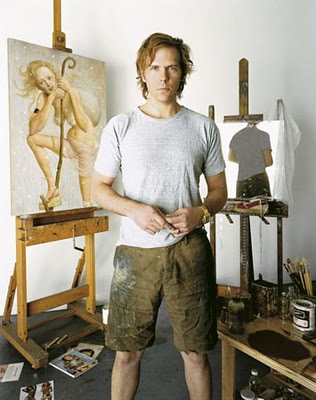
He also happened to be featured in this Art Now anthology I've had since 2005, and I somehow remembered his profile pic because, well, he's quite good-looking.  LOL


That was my previous exposure to John Currin, and I had yet to see any of his work in real life. Until now. (actually, a few weeks ago to be more precise)

My friend and I ventured to the Old Port to DHC/ART.  The gallery also exhibited the strange sculptures of de Bruyckere, but I'll just concentrate on Currin since painting is my forte.

To be frank and blunt: I was dissapointed.  I'm a lover of paint and materials, and I was honestly not blown away.  The images look great in books and even online: his colours, the contrast, composition, are no doubt effective.  However, when viewing work in real life, I expect something more.   Somehow, I didn't feel that extra layer of lush intensity in his paint.  Despite his excellent rendering, the paint fell flat.  But moreover, I suppose I'm not a big fan of his subject matter. It was bizarre, but not in the enticing way.  Some of it was VERY pornographic, and that's fine... but it didn't push my intellect buttons too hard. Nor did it stimulate me, so I wasn't all that impressed. I guess to each, their own!

There were however some jewels that I really enjoyed.  His older works on the first floor were however more solid (in my opinion, of course!) We weren't allowed to take photographs, but here's an idea of his older aesthetic.

Skinny Woman, 1992

Another work that I've seen prior and did enjoy in real life is:

Rachel in Fur, 2002

It was small but compelling. As a portrait, it really drew me in. When a painting is able to have that sort of effect on a person, I think it's very successful.  I couldn't help but stare and wonder about the person in the portrait; I was acknowledging her as an individual and not just a face in a painting.

My friend and I also took some time analysing this painting:

Thanksgiving Wenches, 2003
I remember that the highligts on the woman's shirt were very well done (the paint sat on the top layer). But aside from that, my art history buddy enjoyed the many elements he put into this artwork. 


Conclusion

Maybe I just had higher expectations, but I wasn't blown away. The gallery itself was cool! It stood on 4 floors, the space was more intimate and the lighting was a bit off in certain areas, but all in all, I liked the posh space more than the work on the walls...

John Currin at DHC/ART runs from June  30th 2011- November 13th 2011. Check it out soon to see for yourself!